

Published: 05 August 2026
Tax technology has traditionally been implemented around individual regulatory requirements. A new VAT return, e-invoicing mandate or digital reporting obligation triggered a defined project: requirements were analysed, interfaces built, systems configured and the solution deployed.
That model assumes regulatory change is episodic. Increasingly, it is continuous.
E-invoicing makes this particularly visible. Schemas are updated, validation rules refined, timelines moved and fallback procedures clarified. Multinational organizations must absorb these developments across several jurisdictions while operating multiple ERP systems and local processes. The trend also extends beyond VAT: corporate income tax compliance is becoming more data-intensive, global calculations require more granular information, and tax authorities are expanding digital reporting and audit capabilities.
The challenge for tax departments is therefore not simply to implement the next mandate. It is to build a technology landscape that can absorb recurring change without repeatedly redesigning core systems.
Contain the impact of change
No tax technology environment can be made immune to regulatory change. New obligations will always require interpretation, configuration and testing. The more useful design question is how much of the landscape must change when one requirement changes.
Consider a new mandatory buyer identifier in an e-invoice schema. In a tightly coupled environment, it may affect master data, ERP configuration, invoice generation, middleware, compliance software and exception handling. A limited update becomes a cross-system programme.
A more resilient architecture contains the change. The source and tax meaning of the identifier are defined once, and the relevant country module consumes it through a controlled interface. The local schema may change, but the underlying order-to-cash process should not need to be rebuilt.
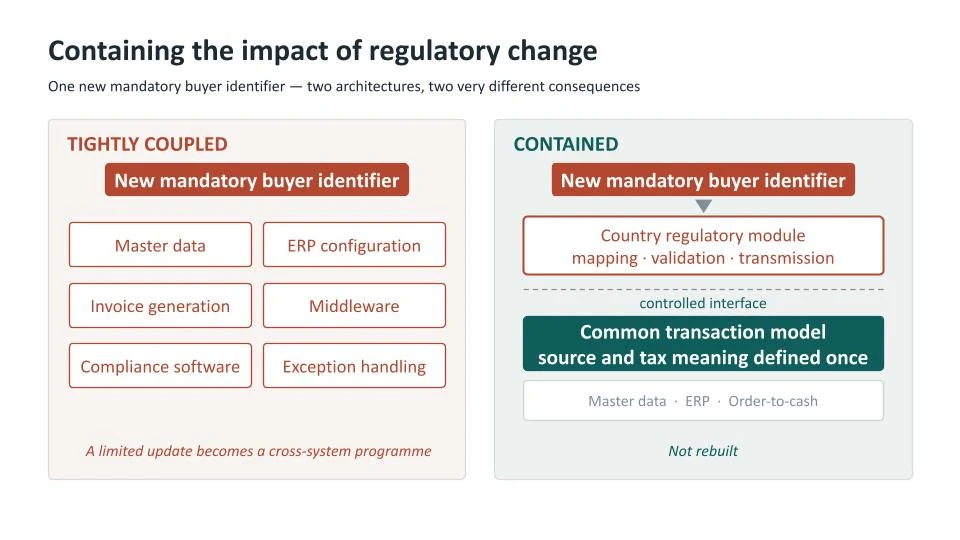
This is the practical purpose of modularity: not to create more applications, but to establish clear boundaries around change.
Design around stable tax facts
Regulatory formats change more frequently than the underlying tax facts.
A tax function still needs to know who supplied what to whom, when and where the transaction occurred, which entities and registrations were involved, what amount was charged and how the transaction was treated. A data-centric architecture starts with these facts rather than with the fields of the latest government schema.
Local invoice, reporting and tax calculation formats then become different representations of the same governed transaction. If a tax authority introduces a new code, splits one field into several fields or changes a validation rule, the organization updates the transformation layer rather than redefining the transaction in every source system.
The objective should be a stable common model with controlled local extensions. This does not mean one inflexible global file. It means defining a core set of tax-relevant facts and adding local attributes only where genuinely required.
The model must preserve meaning, not merely values. A buyer VAT number may refer to the customer’s domestic registration, the registration relevant to the transaction or the number displayed on the invoice. The invoice date, tax point and reporting date may also differ. Unless those distinctions are explicit, each mandate risks creating another definition of the same concept.
Separate components that change at different speeds
A modular tax architecture can be viewed as a sequence:
Source systems → common transaction model → tax determination → country regulatory models and transmission
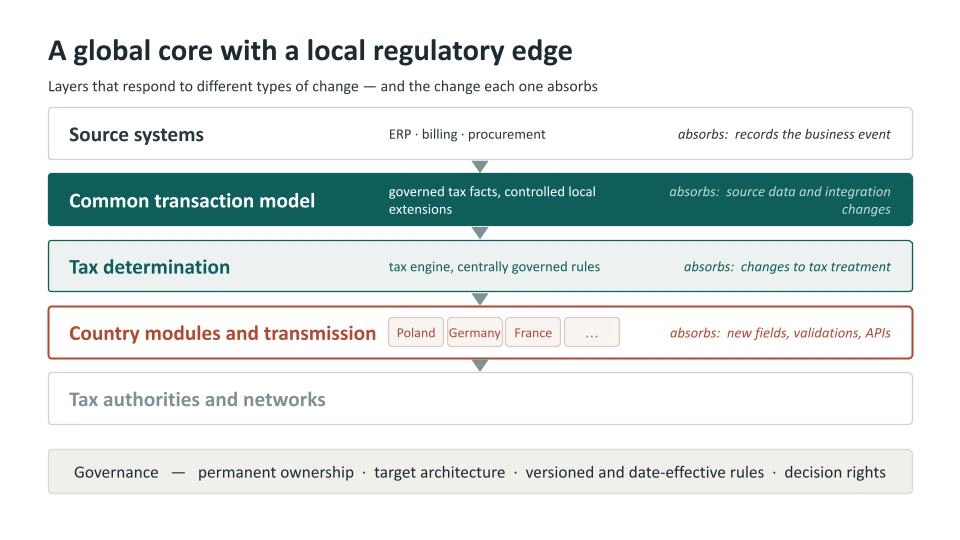
Source systems record the business event. A common model standardizes the relevant data. A tax engine or another determination component may enrich the transaction with the applicable tax treatment. Country modules then convert the result into local invoice, reporting and transmission requirements.
Each layer responds to a different type of change. Changes to source data affect integration and the common model. Changes to tax treatment affect determination. New invoice fields or validations affect the country module. Changes to government APIs or authentication should mainly affect transmission.
Tax engines are one example of this separation. By moving selected tax coding and determination rules outside ERP systems, organizations can reduce the need to update multiple ERP configurations when a tax rule changes. The value is not the tool itself, but the principle: frequently changing tax logic should, where appropriate, sit outside stable transactional processes.
A new government schema should not require the tax decision to be rebuilt in the ERP. Equally, a change in tax treatment should not force a redesign of the e-invoicing interface.
A global core with a local regulatory edge
The growing number of e-invoicing and digital reporting mandates strengthens the case for using a global technology provider across a multinational organization’s regulatory footprint.
The main advantage is not simply country coverage. It is the ability to manage several mandates through a common integration and operating framework.
Instead of building a separate interface for each jurisdiction, the organization can provide data through a consistent integration layer. The provider maps it to local schemas, applies country-specific validations and manages transmission to the relevant authority or network.
Technology providers can increasingly move towards a common enterprise data contract: a stable core dataset supported by controlled local extensions. They can also absorb technical change within regulatory modules, so updates to national schemas, APIs or transmission protocols do not always flow back into each client’s ERP landscape.
A global platform can bring consistency to monitoring and exception management. Rejected documents, missing data, transmission failures and delayed acknowledgements can be handled through one process rather than separate country tools.
Over time, this can create a more stable and economical model. The comparison should include not only licence costs, but also interfaces, upgrades, monitoring, support and vendor management across the portfolio of mandates.
Governance requires permanent ownership
Modularity without governance can create modular chaos.
Continuous regulatory change requires a permanent capability for translating legal developments into controlled technology changes. In larger organizations, this may justify a dedicated tax technology team led by a Head of Tax Technology, Chief Tax Technology Officer or equivalent.
The title matters less than the mandate. The function should coordinate tax, finance, IT and providers; maintain the target architecture; govern the common data model; and decide where new rules should be implemented. It should also challenge local projects that solve an immediate requirement by adding another interface or duplicating tax logic.
Decision rights must remain clear. Local tax teams interpret local requirements. Global tax owns common concepts and cross-market consistency. IT and providers own implementation standards. Business functions remain accountable for source data.
Schemas, mappings, tax rules and validations should be versioned and date-effective, so the organization can establish which logic applied when a transaction was processed.
From implementation to change absorption
Traditional tax transformation programmes measure countries deployed, milestones completed or invoices transmitted. These indicators do not show whether the function has become more adaptable.
A function designed for continuous change should also ask how many systems are touched by a typical update, how long impact assessment takes, how much testing can be reused and how many local exceptions have accumulated.
The objective is not a final-state platform that will remain unchanged. It is a governed data model, modular decision and transmission layers, and a global operating framework in which regulatory change can be absorbed without repeatedly redesigning the tax function.