


Published: 05 August 2026
Why a deliberate tax structure becomes an accidental system design
A group runs a principal model: one entity owns the inventory, bears the stock risk, contracts with toll manufacturers and limited-risk distributors, and sells across Europe. Stock sits in a Dutch warehouse, a Polish one and a Spanish one. Each place where the principal holds or moves its own goods may create a local VAT registration. Within a few years, one legal entity holds a dozen VAT numbers.
That part is usually deliberate. What is less often deliberate is what happens when the structure reaches the ERP.
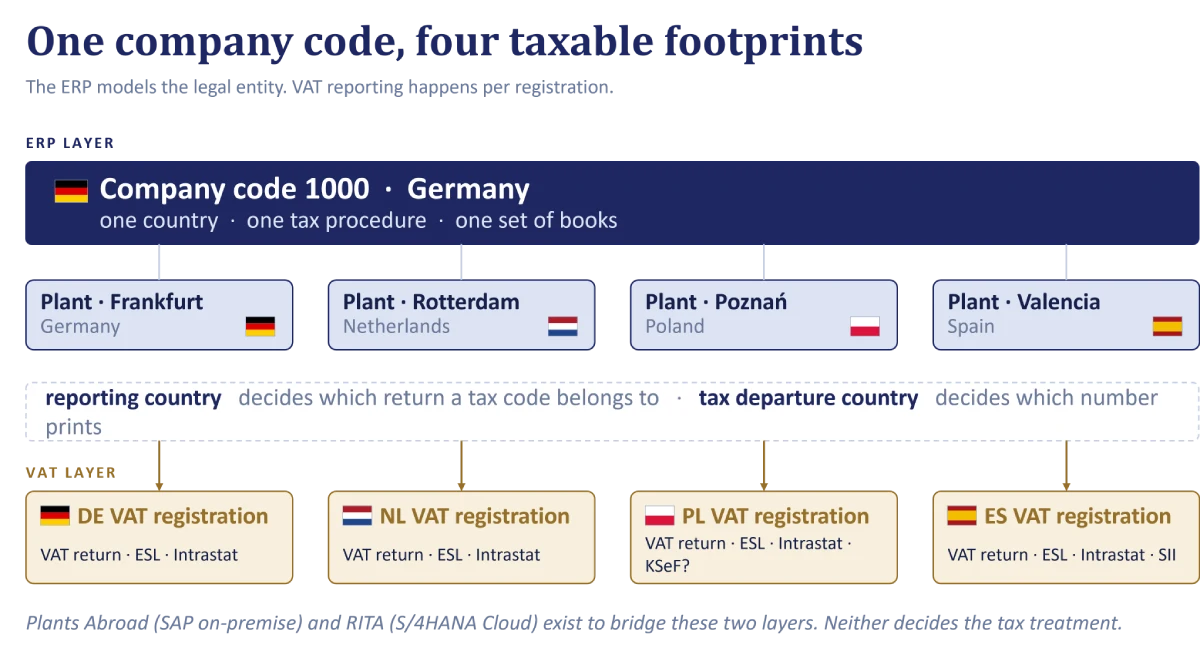
In SAP, the company code is built around the legal entity: one home country, one set of books and a default tax identity. VAT reporting, however, happens per registration. The two levels do not line up, and everything below follows.
Plants Abroad: what it gives you, and what it does not
SAP’s traditional on-premise answer is Plants Abroad: assign plants in other countries to one company code and operate several foreign VAT registrations without creating a company code for each.
Plants Abroad introduces tax country as an additional reporting dimension in tax codes and accounting documents. That is the point. A tax code created in a German company code can carry France as its reporting country, allowing VAT returns to be extracted by jurisdiction rather than by manually assembled groups of tax codes.
In sales processes, the tax departure country can also drive the selection of the foreign VAT registration shown on the invoice. The functionality supports the accounting and reporting of own-goods movements, including their treatment in VAT, ESL and Intrastat processes, and stores tax amounts in the relevant reporting-country currency.
Two caveats come with it.
First, Plants Abroad does not solve tax determination. It can represent the reporting country, VAT ID, stock movement and reporting currency. It does not decide whether a supply carries local VAT, qualifies for exemption or falls under a reverse charge.
Second, it is not a complete localisation solution. SAF-T, mandatory e-invoicing, statutory ledgers, official numbering and other country-specific obligations may still require separate functionality or external compliance technology.
RITA: the newer answer
In S/4HANA Cloud, SAP’s newer answer is RITA, Registration for Indirect Taxation Abroad. It allows one legal entity to calculate and report indirect tax in several countries without creating a local company code.
The design is more registration-oriented than the classic Plants Abroad model. Tax registration countries are activated within the company code, tax configuration is maintained by country and legal reporting is performed in the relevant reporting currency.
The constraint is coverage. RITA is enabled for a defined list of countries, expanded release by release. Support for a tax registration country does not necessarily mean that every related feature, including foreign plant scenarios, is available. Whether a registration is supported therefore has a current answer, not a permanent one.
What a registration does to the answer
All of that is about representing registrations. None of it determines what a registration does to the VAT treatment.
Domestic reverse-charge rules are a simple example. The VAT Directive allows Member States to shift liability to the customer in certain domestic supplies made by a non-established supplier, but the conditions are national. The result may depend on the supplier’s status, including whether it is merely registered or established in the country, and on equivalent criteria on the customer side, such as its registration, establishment and taxable-person status.
A local VAT registration may therefore change the result in one country and be irrelevant in another. The same transaction profile can produce local VAT in one jurisdiction and a reverse charge in the next.
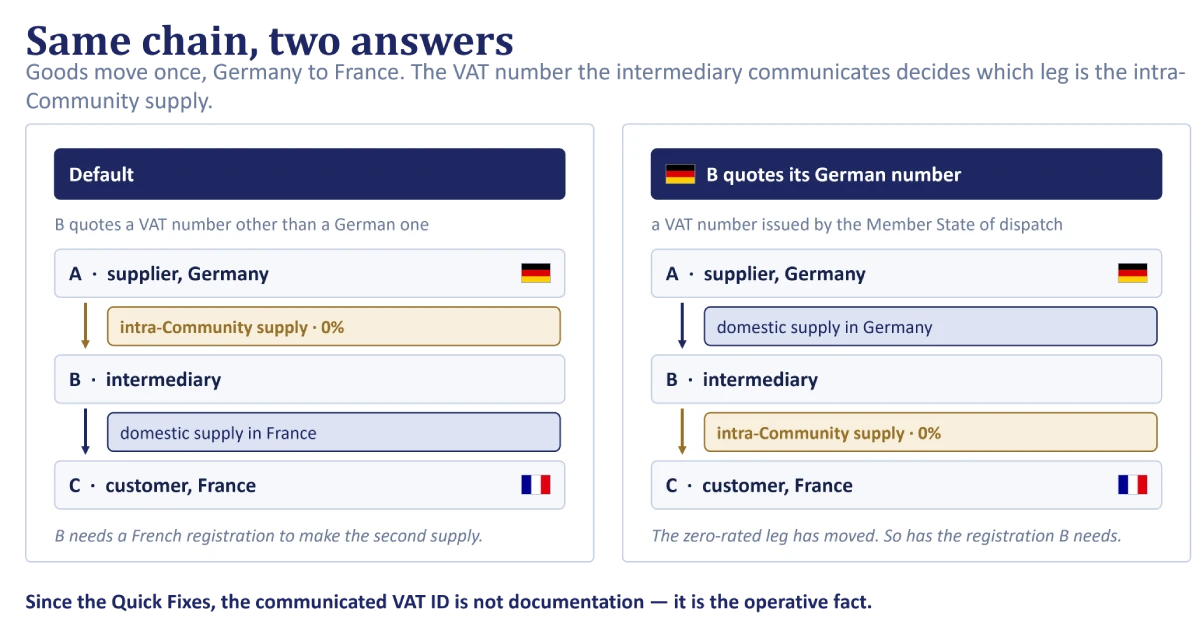
In a chain transaction, the VAT number communicated to the supplier may change the VAT analysis. Under the Quick Fixes, the intra-Community transport is generally attributed to the supply made to the intermediary operator. If that intermediary communicates a VAT number issued by the Member State of dispatch, the transport is instead attributed to the supply made by it.
The VAT ID is therefore not merely evidence. In a chain transaction, the VAT number communicated by the intermediary can determine which supply is treated as the intra-Community supply. For an entity holding registrations in several countries in the chain, the VAT ID used for a transaction may therefore change its VAT treatment.
Triangulation adds another layer. In some Member States, the intermediary’s registration in the country where the transport ends can prevent the simplification from applying. A VAT number obtained for an unrelated activity may therefore remove a simplification elsewhere.
Goods, services and counterparties
Which number applies also depends on what is supplied.
For a standard intra-Community movement of goods, the seller will generally use the registration of the country of departure, while the buyer uses the registration of the country of arrival. Local supplies, imports and chain transactions require a different analysis.
For services, the analysis generally starts with the establishments involved rather than the physical movement of goods. The relevant VAT identity may therefore be linked to the head office or to a fixed establishment that receives or supplies the service.
The issue is not limited to the company’s own numbers. A supplier delivering goods from several countries may invoice under several VAT registrations. A vendor master holding only one default VAT ID cannot accurately represent a counterparty registered in four jurisdictions.
The system must therefore hold registration-level data and validate the VAT ID used on the document against the actual supply flow. Otherwise, the wrong VAT treatment will appear sooner or later.
When a registration is no longer the whole story
A VAT registration may initially reflect little more than stock held in a country. Over time, however, the operating model can change.
A warehouse acquires staff. Local personnel begin making operational decisions. A contract manufacturer takes on additional functions. A separate question then arises: does the entity now have a fixed establishment for VAT purposes, or a permanent establishment for direct tax?
The two tests are separate. One does not automatically imply the other.
A fixed establishment can materially change the VAT analysis, particularly for services, where the place of supply may depend on which establishment receives or performs the service. A permanent establishment may require separate accounting records and can reopen the question whether one company code remains the right system design.
A fixed establishment may also affect mandatory e-invoicing.
Poland is a useful example. The KSeF issuing obligation does not arise merely because a foreign entity holds a Polish VAT number. The analysis also considers whether the entity has a fixed establishment in Poland and whether that establishment participates in the transaction. A Polish registration alone does not answer the mandate question.
Representation is not interpretation
Plants Abroad and RITA represent, inside a structure built around the legal entity, something that the structure does not natively contain.
They work. But they represent the registration; they do not interpret it.
Whether a VAT number belongs on a particular invoice, whether it removes a reverse charge, whether it changes a chain transaction or whether the local activity has created a fixed establishment, those answers sit outside the system, and they move as the operating model changes.
None of this is simply data quality. It is knowing what each registration means, when it applies and what the system has already assumed about it.