

Published: 20 July 2026
Why clean tax data is critical for e-invoicing, digital VAT reporting and tax technology projects
As tax authorities move towards digital VAT compliance, invoice data is increasingly structured, validated and transmitted through central government platforms, such as those used in Italy, Romania or Poland. This makes VAT master data more important than ever.
Many tax errors do not start with VAT law interpretation or technology configuration. They start earlier, in the quality and structure of the master data used by tax, finance, billing, procurement and reporting processes.
Inaccurate or inconsistent VAT master data can lead to incorrect VAT treatment, invoicing errors, reporting inaccuracies, failed e-invoicing validations and increased tax audit exposure. High-quality VAT master data is therefore not just a technical requirement. It is a prerequisite for effective VAT compliance and successful e-invoicing implementation.
How master data becomes a VAT error
In many ERP environments, VAT treatment is operationalized through tax codes. A tax code may determine the VAT rate, posting logic, invoice wording, reporting category and the data used for e-invoicing or digital VAT reporting.
However, the tax code itself is usually determined based on several master data and transactional attributes. These may include the seller’s VAT registration, buyer VAT ID, ship-from country, ship-to country, bill-to address, customer tax classification, product or service category, transaction type or plant data.
A simplified logic may look as follows:
master data attributes + transactional data = tax code
tax code = VAT rate + invoice content + reporting logic
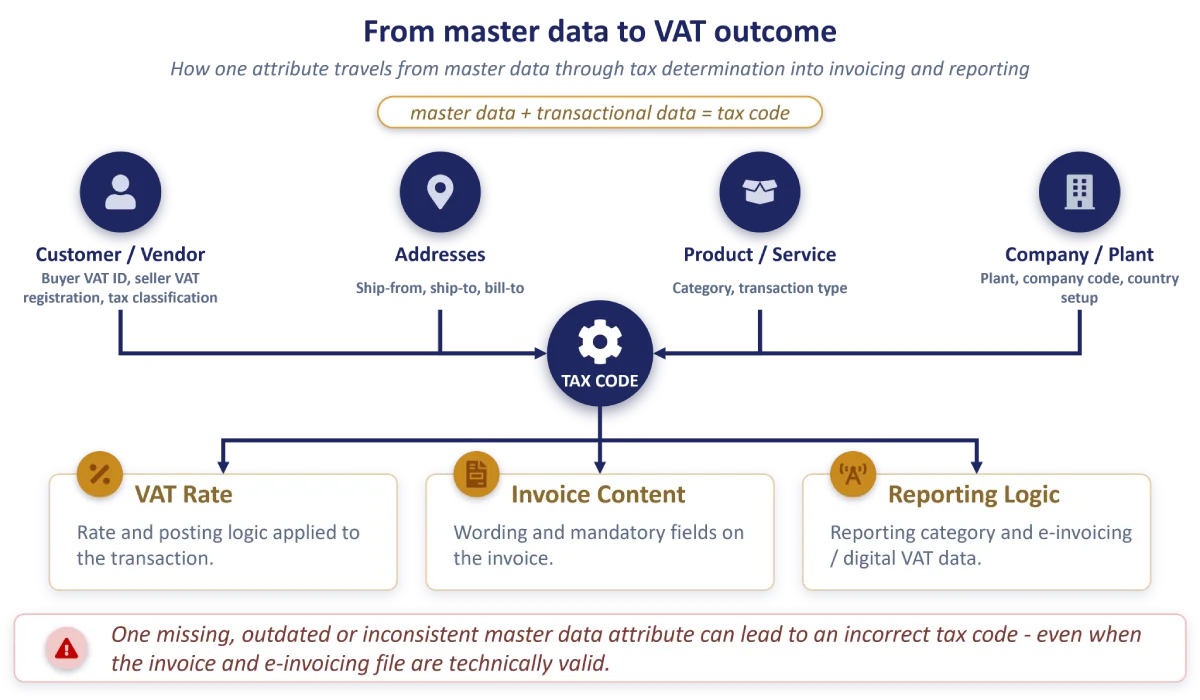
This is where master data becomes critical. The buyer VAT ID may come from the customer master, the ship-to country from the address master, product classification from the material master, and the seller’s VAT registration from company code, plant or country setup.
If one of these data points is missing, outdated or inconsistent, the system may determine an incorrect tax code. The invoice may still be generated, and the e-invoicing file may even be technically valid. But the VAT result may be wrong.
Practical examples from ERP and e-invoicing projects
Master data issues are easiest to understand through transaction scenarios. In large organizations, VAT errors often arise not because the tax logic is completely wrong, but because one data point feeding that logic does not reflect the real business flow.
A frequent issue concerns VAT IDs in chain transactions, a scenario often seen in principal structures. Chain transactions are complex from a VAT perspective, and reflecting them correctly in ERP logic can be challenging. The VAT ID used by each party and the actual flow of goods are often critical for determining the correct VAT treatment.
For example, one customer may have several VAT registrations because it is registered in multiple countries. The VAT ID used for a given transaction may depend on the ship-to location, transaction leg, role of the party or country from which the goods are moved. If the ERP derives a default VAT ID instead of the VAT ID relevant for that specific transaction, the supply may be classified incorrectly.
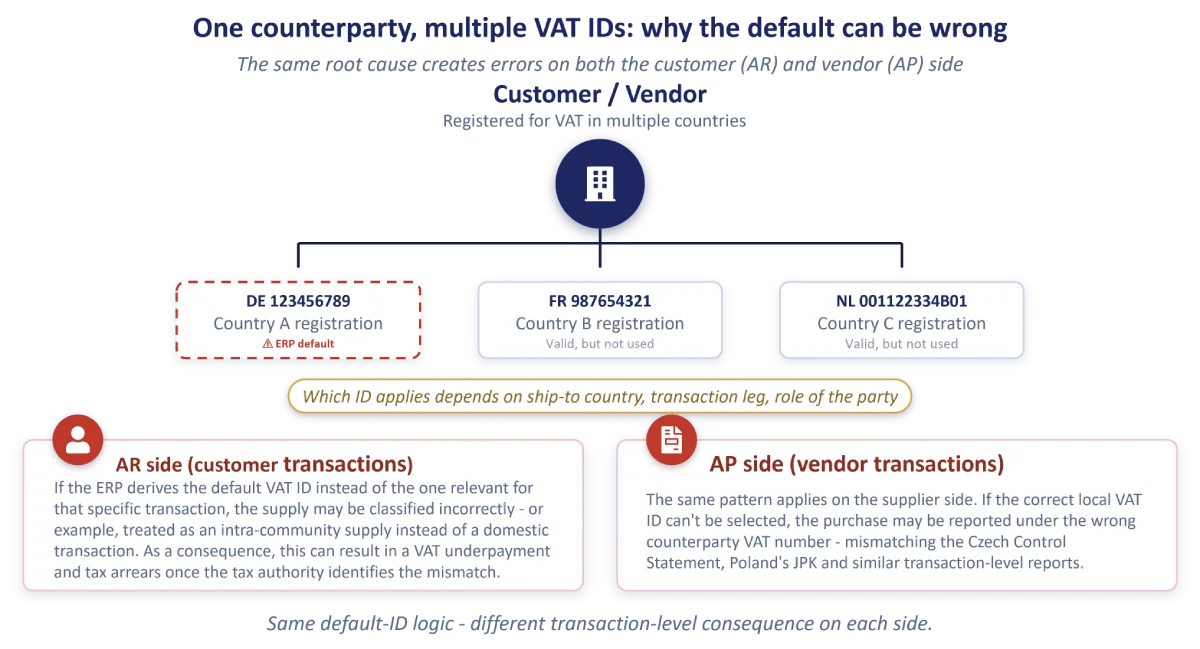
A similar issue may appear on the accounts payable side. A supplier may be registered for VAT in several countries but maintained in the ERP under one default VAT ID. For a specific purchase, the supplier may use a different local VAT registration. If the vendor master data does not allow the correct VAT ID to be selected or derived, the company may report the purchase under the wrong counterparty VAT number. In transaction-level VAT reporting, such as the Czech Control Statement or Poland’s JPK, this can lead to reporting mismatches, incorrect transaction classification and follow-up questions from the tax authority.
These examples show that VAT master data is not just a customer or vendor database issue. It is embedded in how transactions are classified, taxed, invoiced and reported.
Why e-Invoicing raises the stakes
In traditional VAT compliance models, some data issues could be corrected manually after the invoice was issued or during VAT return preparation. E-invoicing and continuous transaction controls change this dynamic.
In clearance or near-real-time reporting models, invoice data may need to be validated, structured and transmitted before or shortly after issuance. If the master data is incorrect, the issue appears earlier and may result in invoice rejection, failed validation, incorrect reporting, customer disputes or downstream compliance errors.
This is particularly important in jurisdictions with central government e-invoicing platforms. In such models, errors are not only internal process issues. They may be immediately visible to the tax authority. A wrong VAT ID, incorrect address, inconsistent buyer data or inaccurate tax classification may prevent clearance, trigger a validation error or create a mismatch in transaction-level reporting.
There is also a technical master data challenge: the format in which data is stored in the ERP may not match the format required by the local e-invoicing XML schema. For example, a company may store VAT IDs in one ERP field as a combined country prefix and number, such as “DE1234567890”. However, a local e-invoicing structure may require the country prefix and the VAT number in separate XML fields. If this mapping is not properly addressed, data that looks complete in the ERP may still be presented incorrectly in the e-invoicing file.
This is why data that was previously “good enough” for PDF invoices or manual compliance may no longer be sufficient. Master data must not only be accurate; it must also be structured in a way that can be correctly mapped, transformed and reported.
Master data governance as a VAT control
VAT master data should be treated as a dedicated workstream in any e-invoicing, continuous transaction controls, ERP transformation or tax technology project. The objective is not only to populate mandatory fields. It is to understand which data attributes drive VAT outcomes and which fields are required for local reporting schemas.
Organizations should identify which master data fields influence tax code determination, invoice content and e-invoicing reporting, including customer and vendor VAT IDs, legal names, addresses, country codes, product and service classifications, VAT registrations, transaction types, ship-from and ship-to locations, bill-to data and plant or company code setup.
Master data should also be tested against real transaction flows, not only in isolation. Domestic sales, intra-EU supplies, exports, imports, intercompany transactions, chain transactions, drop shipments and service flows may all use different combinations of master data attributes.
Finally, ownership should be clear. Tax teams do not need to own every customer, vendor or material record, but they should have visibility and control over tax-relevant attributes.
Reliable VAT compliance starts with master data
E-invoicing platforms, tax engines and compliance tools can improve efficiency, reduce manual work and support standardization. But they can only deliver reliable results if the underlying data is fit for purpose.
Before companies automate VAT compliance or connect their processes to tax authority platforms, they need to make sure their VAT master data is ready.
Technology can structure, validate and transmit data. But it cannot turn unreliable master data into reliable tax compliance.