

A Complete Guide to the PEPPOL Network
Global trade is becoming increasingly digital. Businesses no longer exchange only paper invoices or PDF documents, they exchange structured electronic documents that can be processed automatically by ERP systems and tax authorities. As governments introduce mandatory e-invoicing regulations and businesses expand internationally, interoperability has become one of the biggest challenges in digital procurement.
The PEPPOL (Pan-European Public Procurement On-Line) network addresses this challenge by providing a standardized framework for exchanging electronic business documents securely across borders. Originally developed for European public procurement, PEPPOL has evolved into a global interoperability network used by governments and private companies to simplify electronic document exchange while supporting digital tax compliance.
What is PEPPOL?
PEPPOL is much more than an e-invoicing network. It is an international framework that standardizes how businesses exchange procurement documents electronically. Rather than defining only an invoice format, PEPPOL provides a complete ecosystem consisting of standardized document specifications, secure communication protocols, participant discovery services, and governance rules that ensure interoperability between organizations.
It allows a secure and real-time exchange of all electronic procurement documents (e-Orders, e-Invoices and e-Transport Documents) in the same format nationally and internationally. Nowadays it is widely used by public agencies and private companies all over the world; today, organizations in countries such as Germany, France, Belgium, the Netherlands, Italy, Norway, Sweden, the UK, Singapore, Japan, Australia, New Zealand, Malaysia, and Poland actively exchange electronic documents through the PEPPOL network, with adoption continuing to expand worldwide.
PEPPOL supports the electronic exchange of:
- Electronic Invoices
- Credit Notes
- Purchase Orders
- Order Responses
- Order Agreements
- Catalogues
- Dispatch Advice
- Transport Documents
Because every participant follows the same technical standards, organizations can exchange documents regardless of their ERP system or software provider.
PEPPOL is based on:
- the network: PEPPOL e-Delivery Network.
- the document specifications: PEPPOL Business Interoperability Specifications ‘BIS’
- the legal framework that defines the network governance: PEPPOL Transport Infrastructure Agreements – TIA
How does PEPPOL work? Learn how to connect to Peppol.
Organizations can connect to the PEPPOL eDelivery Network via a PEPPOL Access Point (AP) and easily reach other Peppol users. Only one connection point is required. PEPPOL is a four corner model where sender and receiver have their own access points. Documents (e-Catalogue, e-Orders, e-Delivery Notes, e-Invoices and so on) are exchanged through these certified access point providers. SNI is a certified AP provider.
When an invoice is created:
- The supplier generates a structured electronic invoice.
- The invoice is sent to the supplier’s certified PEPPOL Access Point.
- The Access Point validates the document according to PEPPOL Business Interoperability Specifications (BIS).
- The document is securely routed through the PEPPOL Network.
- The buyer’s Access Point delivers the invoice directly into the buyer’s ERP or accounting system.
This architecture removes the need for complex point-to-point integrations while ensuring secure and standardized document exchange.
Peppol e-Delivery Framework:
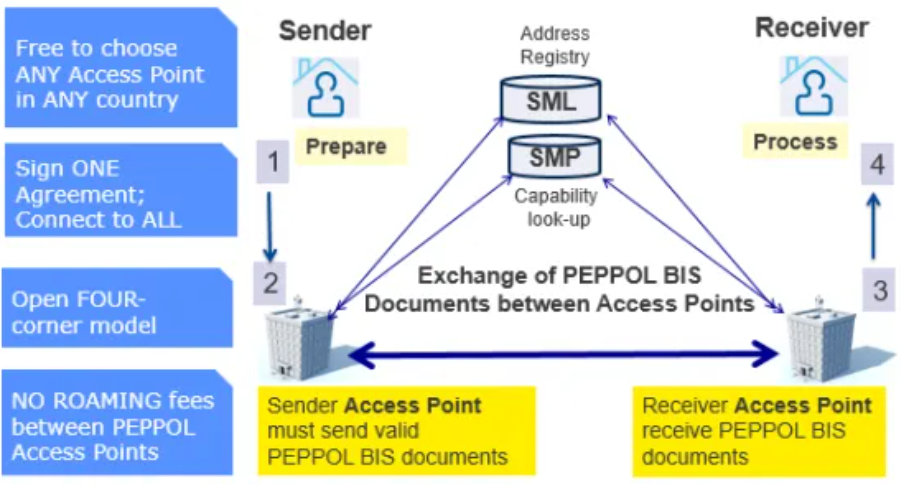
Source: Peppol.eu
What problems does PEPPOL solve? What is PEPPOL used for?
Four corner model of Peppol is simpler and more flexible compared to other transmission models. Because senders and receivers do not need to set up p2p connections or use the same service provider. Once connected to an access point, the Peppol ID is sufficient to send an electronic document to any participant.
What is a Peppol ID?
Peppol ID or Peppol Endpoint ID is the unique address/identification number assigned to the Peppol participants. Senders indicate this ID on Peppol invoices and other documents so that documents reach the correct recipients.
What does PEPPOL consist of?
In addition to the sender and receiver of the e-Documents, Peppol consists of:
- Peppol Access Points (APs)
PEPPOL network is accessible through Peppol APs. Any organization on the network can become an Access Point by meeting the specifications published.
- PEPPOL Service Metadata Publishers (SMPs) publishes the capabilities of PEPPOL participants such as delivery addresses, business processes and document types supported using a separate service.
- The PEPPOL SML (central registration system for addressing)
All Access Points need to know about each other and the participants they support in order to deliver the documents successfully. Service Metadata Locator (SML) service defines which SMP to use for finding out the delivery details of any Peppol participant. It is a core service that identifies all trusted SMPs and APs.
How is PEPPOL usage charged?
There are no roaming fees between Access Points: Although you pay to use services of your access point provider, when connecting to your customers using different service providers, you cannot be charged extra fees.
What is Peppol BIS? What’s the difference between Peppol and Peppol BIS?
Business Interoperability Specifications (BIS) is one of the main pillars of Peppol as defined above. PEPPOL developed BIS to standardize the electronic documents exchanged and validated through the edelivery network The PEPPOL BIS ensures interoperability of procurement documents, such as eInvoices.
These specifications are used when issuing invoices through Peppol-Ready Accounting or ERP Solutions. The latest version is BIS 3.0.
PEPPOL BIS vs PINT
One of the most common questions is the difference between PEPPOL BIS and PINT.
PEPPOL BIS (Business Interoperability Specifications) defines the standardized business rules used throughout the PEPPOL Network. The most widely adopted specification is PEPPOL BIS Billing 3.0, which standardizes electronic invoices and credit notes.
PEPPOL International Invoice (PINT) builds upon BIS Billing by introducing an international invoice model that countries can extend with local regulatory requirements while maintaining interoperability. Countries including Japan, Malaysia, Singapore, and the United Arab Emirates have adopted country-specific PINT implementations as part of their national e-invoicing frameworks.
Peppol Directory
Peppol directory is a free-to-browse service that helps network participants to find each other and identify each other’s data such as Company Name, PEPPOL Endpoint ID, Country and Document Receiving Capabilities.
What is OpenPEPPOL?
OpenPEPPOL is a non-profit international association responsible for the development, implementation and maintenance of the PEPPOL services across Europe. Its members are from both public and private sectors.
It aims to enable organizations to manage all e-Procurement processes easily, eventually providing greater competition in public procurement and international trade. Membership and signing the Transport Infrastructure Agreements (TIA) are mandatory for PEPPOL Authorities, Access Point Providers and Service Metadata Publisher Providers.
Why Are Governments Adopting PEPPOL?
Many governments are moving away from paper invoices and isolated national platforms toward internationally recognized standards.
PEPPOL helps governments:
- improve tax transparency,
- reduce VAT fraud,
- automate public procurement,
- simplify cross-border trade,
- standardize electronic invoice exchange,
- support digital tax reporting initiatives.
This is why several countries have incorporated PEPPOL into their national digital transformation strategies.
Examples include:
- Belgium – mandatory B2B e-invoicing through PEPPOL
- Germany – EN16931 and PEPPOL-supported invoice exchange
- France – PEPPOL-compatible invoice exchange through accredited platforms
- Singapore – nationwide InvoiceNow initiative
- Australia and New Zealand – government-backed PEPPOL framework
- Japan – PEPPOL BIS JP and PINT JP
- Malaysia – PEPPOL-based national interoperability
- United Arab Emirates – PEPPOL-based five-corner model using PINT AE
Future of Peppol
Several countries have announced plans to adopt Peppol as part of their mandatory e-invoicing frameworks. France, Australia, and Japan have since introduced PEPPOL-based or PEPPOL-compatible frameworks (see the country examples above). The USA is also preparing for an e-invoicing framework which will include Peppol.
Peppol International Invoice (PINT), which provides cross-border interoperability out of Europe, has already been adopted through country-specific implementations in Japan, Malaysia, Singapore, and the United Arab Emirates. Ongoing developments include the Peppol continuous transaction controls (CTC) model, which supports delegated clearance and indirect tax reporting models.
Business Benefits of PEPPOL
For businesses, PEPPOL offers far more than regulatory compliance.
A standardized electronic document exchange network enables organizations to automate procurement processes while reducing operational costs.
Key benefits include:
- Faster invoice processing
- Reduced manual data entry
- Lower integration costs
- Improved data quality
- Secure document transmission
- Simplified supplier onboarding
- Cross-border interoperability
- Support for multiple ERP platforms
- Standardized electronic procurement
Instead of maintaining dozens of customer-specific integrations, organizations maintain only one secure PEPPOL connection.
Why PEPPOL Matters for Cross-Border Trade
Cross-border invoicing often requires companies to comply with different invoice formats, validation rules, and transmission methods.
Without interoperability standards, suppliers frequently build country-specific integrations that increase implementation costs and maintenance efforts.
PEPPOL solves this by providing one standardized communication layer that supports multiple jurisdictions while allowing countries to introduce local business rules through BIS extensions or PINT specializations.
This significantly simplifies international digital trade and helps organizations scale their operations without rebuilding their invoicing infrastructure for every new market.
How Can SNI Help You About PEPPOL?
SNI is an official OpenPeppol Certified Access Point Provider, enabling organizations to exchange electronic procurement documents securely through the global PEPPOL Network.
SNI provides a complete end-to-end PEPPOL solution that supports the entire document lifecycle, from ERP integration and document generation to validation, transmission, inbound processing, monitoring, and compliance.
With SNI’s solution, businesses can:
- Exchange invoices, credit notes, purchase orders, and other PEPPOL documents through the certified PEPPOL Network.
- Generate PEPPOL BIS Billing 3.0 and country-specific PINT-compliant documents.
- Connect to a single certified Access Point instead of maintaining multiple customer-specific integrations.
- Automatically validate documents before transmission according to official PEPPOL specifications.
- Receive inbound documents directly into SAP or non-SAP ERP environments.
- Monitor document status through the user-friendly SNI e-Document Cockpit.
- Automate inbound invoice processing and reconciliation by matching invoices with purchase orders, delivery notes, or internal financial records.
- Integrate seamlessly with SAP ECC 4.7+, SAP R/3, SAP S/4HANA, SAP Business Technology Platform (BTP), while also supporting ERP-independent environments.
By combining certified PEPPOL connectivity with deep expertise in global e-invoicing regulations, SNI enables organizations to simplify cross-border document exchange, improve operational efficiency, and maintain compliance across multiple jurisdictions through a single integrated solution.
What is SNI's role in the Peppol network, and what value-added services does it offer as an Access Point?
SNI is an accredited Peppol Service Provider, authorized for both sending and receiving e-documents through the Peppol network. As a certified Access Point, SNI enables seamless, secure data exchange between trading partners and tax authorities. In addition to basic connectivity, SNI offers value-added services such as format conversion, validation, archiving, monitoring, and automated inbound invoice processing and reconciliation.
How does SNI help customers ensure legal compliance for cross-border transactions and Peppol regulations in different countries?
SNI continuously monitors Peppol EU regulations and local tax authority updates to ensure its clients remain compliant across all jurisdictions. Our solution supports country-specific Peppol BIS formats and PINT specifications, validation rules, and legal archiving requirements. Leveraging SNI’s centralized Peppol Network Access Point, companies can share compliant e-invoices and documents internationally while meeting both local and cross-border legal obligations.
What are the steps involved in launching the Peppol application with SNI, and how long does end-to-end integration take?
The process typically includes: (1) initial Peppol registration not required and configuration done in the Peppol Guide, (2) connection setup between the SNI Access Point and your ERP system (for example, SAP Peppol integration), (3) testing and validation, and (4) go-live authorization. End-to-end integration typically takes 6-8 weeks, depending on your system environment and country coverage.
What is a Peppol ID, and how can I register and start using a unique Peppol ID for my organization via SNI?
The Peppol ID is a unique digital identifier that allows your company to securely send and receive documents within the Peppol Network. Using the SNI Access Point, you can easily register your organization in the Peppol Directory, obtain your unique ID, and activate it for cross-border e-invoice exchange. The SNI manages the entire onboarding process, including validation and synchronization with Peppol EU standards.
How can I seamlessly integrate SNI's Peppol services with my existing ERP or accounting systems (e.g., SAP, Oracle, etc.)?
SNI offers ready-to-use connectors and certified integration options for leading ERP systems such as SAP, Oracle, and Microsoft Dynamics. The integration is designed to run independently within your ERP environment, enabling document creation, validation, and submission directly through the Peppol Network without manual intervention. SNI integrates seamlessly with SAP ECC 4.7+, SAP R/3, SAP S/4HANA, and SAP Business Technology Platform (BTP), while also supporting ERP-independent environments.
How does SNI ensure and manage data security, privacy, and local legal compliance (KVKK, GDPR, etc.) within the Peppol framework?
SNI strictly complies with GDPR, and Peppol EU data protection requirements. All document exchanges within the Peppol Network are end-to-end encrypted, and SNI ensures that data is stored and protected in accordance with local laws. Our hosting infrastructure is ISO-certified, and all connections made through the SNI Access Point comply with Peppol security and authentication protocols.
What are the first steps and requirements for starting to work with Peppol using SNI?
To get started, customers need to provide basic company information, VAT or basic company information, and ERP system configuration. SNI then creates the organization profile in the Peppol Directory, assigns a Peppol ID, connects the system to the Peppol Network, and performs end-to-end testing to ensure it’s ready for live document exchange.
What are the fundamental differences between Peppol's primary communication mechanism, the 4-corner model, and the rarely used 5-corner model, and how do they work?
4-corner vs 5-corner: The 4-corner model is the core communication structure of the Peppol Network and consists of a sender, a receiver, and two Access Points; each side connects via its own Access Point for interoperability. The 5-corner model adds a centralized authentication or intermediary node (often used in specific national implementations) but is less common in the broader Peppol EU ecosystem. For example, the United Arab Emirates uses a PEPPOL-based five-corner model with PINT AE. SNI supports both models, providing flexibility for country-specific deployments.
Is Peppol mandatory in the country or sector where I operate (e.g., e-invoicing or public procurement), or is it expected to become mandatory in the near future?
Peppol adoption varies by country. In some EU and Asia-Pacific markets, Peppol is already mandatory for B2G or even B2B transactions (for example, in Belgium, France, and Malaysia). SNI continuously tracks each regulation’s roadmap within Peppol EU to help clients anticipate upcoming mandates and prepare early through their SAP or other ERP integrations.
What are the differences in roles and responsibilities between a Service Provider and an Access Point in Peppol terminology?
The Peppol Service Provider provides connectivity and value-added services such as integration, authentication, and monitoring. Like the SNI, a Peppol Access Point is officially accredited within the Peppol Network to transmit documents between senders and recipients. In short, the Access Point ensures interoperability and compatibility, while the Service Provider enhances availability through ERP integration, analytics, and support.